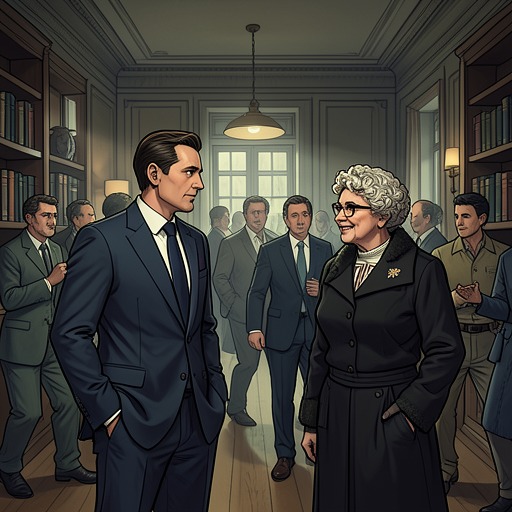
The planner’s September murder scheme
Towards ZeroThe planner’s September murder scheme is a carefully constructed design for killing someone, written on February 14 and then destroyed so that its details survive only in the planner’s mind. Its importance lies not just in the intended murder but in the contrast between the plan’s meticulous preparation and the evidence that later has to be interpreted: possible means, suggestive fingerprints, and a sequence of events that can alter what an apparent clue seems to prove.
Composition and Intended Design
On February 14, the scene isolates a single person in a room, with only the scratching of a pen audible. The pages contain a clear, carefully detailed project for murder. The passage initially withholds the writer’s identity, presenting the figure through the act of planning rather than through a name or biography. That anonymity makes the scheme itself the first fact the reader must confront: the murder is not described as an impulse, but as an objective being methodically prepared.
The planner is depicted as exercising deliberate control, with one purpose occupying the mind: the destruction of another human being. The plan accounts for every eventuality and possibility while leaving room for unforeseen events. Its main lines are tested, but it is not entirely fixed in advance; certain actions are to occur at particular points, alongside provision for circumstances that cannot be predicted. The passage therefore defines the scheme as both rigid in purpose and adaptable in execution.
The planning extends beyond practical arrangements. The writer anticipates how everyone will react and intends to play upon the good and evil in different people, bringing their responses into alignment with one design. This makes other people’s likely conduct part of the plan’s machinery. The passage does not disclose the specific victim, method, or sequence of actions, but it emphasizes that the planner has considered the time, place, method, and victim. One element remains incomplete until the writer traces a date in September onto the page.
Destruction and Concealment
After reviewing the pages carefully, the writer appears satisfied that the scheme is clear. The scene describes a smile that is not quite sane and compares the planner’s satisfaction to a distorted creator’s joy. The image gives the act of planning a disturbing sense of authorship: the design has been made, tested, and brought into focus, but its intended outcome is the destruction of another person.
The writer then tears the papers into pieces and carries them to the fire. Every piece is consumed; the destruction is deliberate rather than careless. With the written record gone, the plan is no longer available for anyone else to read or verify. It exists only in its creator’s brain. The burning thus completes the scheme’s concealment while also shaping how it can later be understood: the reader has been shown that a plan exists, but its surviving particulars must be inferred from events and evidence elsewhere in the story.
Later Evidence and Uncertain Inference
The subsequent inquiry supplies clues that make the planned murder relevant to the investigation of Lady Tressilian’s death, but the evidence requires qualification. Dr. Lazenby says that a heavy Golf club (niblick) could have been the weapon, not that he can swear it was. He proposes testing the blood and hairs on it. Superintendent Battle’s careful question distinguishes possibility from certainty: the object may have been used, but the medical evidence has not yet established that it was.
Nevile Strange recognizes the Golf club (niblick) as his property and explains that his fingerprints would be present because he had handled it. Battle then sharpens the issue, asking why the prints indicate that Nevile was the last person to handle it. This makes the object more than a possible weapon: its ownership and handling become part of the case against him. Yet the distinction between a suggestive trace and proof remains central to the inquiry, just as the original scheme depended on anticipating how appearances and other people’s actions could be made to serve a design.
Timing supplies another qualification. Battle tells Nevile that, after Nevile left Lady Tressilian, she rang for her maid; Barrett saw her afterward, alive and well, and also saw Nevile leave the house before Barrett entered. These details establish that Lady Tressilian was alive after Nevile’s departure. They complicate any simple account based solely on an argument or on the apparent significance of the Golf club (niblick), and show why the sequence of events matters as much as the clues themselves.
Narrative Function
The scene of composition precedes the later investigation in the telling, making the anonymous writer’s foreknowledge available to the reader before the case can interpret its evidence. The date written on the pages points toward September, while the destroyed document prevents the plan from serving as a straightforward record against its creator. The narrative instead sets a deliberate design beside clues that admit degrees of certainty: an object that might be the weapon, fingerprints that identify a last handler, and testimony that fixes when Lady Tressilian was still alive.
That structure keeps planning and proof distinct. The February scene establishes intention and preparation, including the writer’s expectation that other people’s reactions can be manipulated. The later questioning tests what can actually be established from physical traces and timing. The scheme’s most consequential surviving feature is therefore not a written instruction but the gap between a carefully imagined outcome and the fragmentary evidence through which the inquiry must reconstruct it.